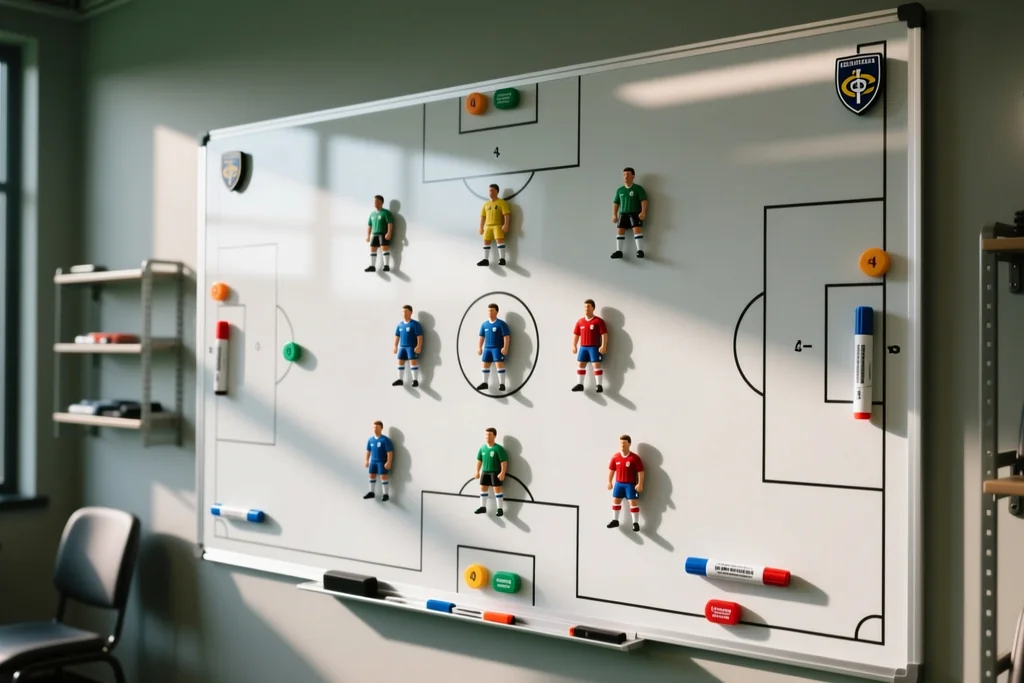
There is a phrase coaches in the Indian Super League reach for often enough that it has become shorthand: the Indian core. It means the group of domestic players who carry a squad through the parts of a season that no signing announcement can repair.
Imports decide individual matches. The Indian core decides whether a club is still competitive when those imports are injured, suspended or simply out of form. That is the quiet argument behind the way the better-run ISL clubs are now assembled, and it is worth taking seriously before the new campaign begins. The wider picture sits on our ISL hub.
A league that has to be built from home
No Indian club can buy its way out of the domestic game. The league's structure, its calendar and its national purpose all point the same way: the quality of the Indian contingent sets the ceiling. Two or three imports can transform a team in the final third, but the spine underneath — goalkeeper through central midfield — usually has Indian names on it.
That is why recruitment conversations at ISL clubs increasingly begin with who is leaving rather than who is arriving. Losing a dependable Indian centre-back costs more than the fee column suggests, because his replacement has to learn the league, the climate and the coach in a matter of weeks rather than months.
What an Indian core actually buys
Continuity is the obvious benefit. A player three seasons into a club knows the triggers, the set-piece routines and the way the dressing room absorbs a bad run. That knowledge is not transferable, and no transfer window can import it.
There is also a harder, more practical edge. Domestic players tend to take responsibility in the moments imports are judged on — the last ten minutes, the defensive corner, the away match where the pitch is heavy and the legs have gone. Coaches notice who still wants the ball in those minutes, and it shapes the team they pick in the spring.
| Function | What it looks like on a matchday | How you spot a weak one |
|---|---|---|
| Continuity | A settled shape that survives rotation | Every injury forces a new system |
| Communication | Instructions relayed in real time | Confusion over set-piece marking |
| Accountability | Players demanding the ball under pressure | Sideways passes when the game is tight |
| Identity | A style the crowd recognises | A team that plays like whoever it last signed |
Read that table as a checklist rather than a verdict. Very few clubs tick all four boxes in September, and none of them has to. What matters is the direction of travel: a club that improves two of those areas over a season is usually a club climbing the table, even when its transfer business attracts no headlines at all.
The development question
The Indian core does not appear by accident. It is produced by academies, by the second tier and by coaches willing to hand a young player a run of games instead of a single cameo. The temptation is always to protect a result with experience; the clubs that resist it long enough end up with a squad that costs less and lasts longer.
There is a commercial case here too, and it is easy to miss. A domestic player who came through the club's own system is cheaper than an equivalent import, is already settled in the city, and gives the supporters somebody to identify with. Clubs that invest in that pathway are not being sentimental; they are buying an asset with a longer shelf life than any short-term signing.
What to watch this season
- Which clubs start with an Indian player in the creative spine, not only in defence
- How quickly young squad members are trusted in away matches, where the pressure feels different
- Whether the Indian contingent keeps its minutes after a poor result — that is the real test of intent
Frequently asked
Why focus on Indian players rather than on signings? Because the domestic core is the part of a squad a club can control year after year, while imports change with every window.
Where can I follow the clubs? Our club pages carry the teams and the context for the season ahead.
The clubs that treat their Indian players as the plan rather than as the paperwork tend to be the clubs still in the conversation in April.
None of this is a knock on foreign signings. The ISL needs them, and the best ones raise the level of everyone around them. But a squad built only from the top down is fragile, and a league built only from the top down never grows. Before the first whistle of a new season, the most revealing thing to study at any club is not the marquee arrival. It is the depth and the quality of the players who were already there — the ones listed at every club in our club directory.